
Shared Standards Are Only the Beginning
Published
September 21, 2026
Editor's note: Joe Varnas is Vice President of Strategic Business Operations at Alcove. He spent seven years building registry and environmental market infrastructure at S&P Global and Xpansiv before joining.
On August 20, Gold Standard and Verra launched a joint tool to help host countries report corresponding adjustments under Article 6.2. It gives a government one record of the adjustments owed across credits authorized by either body, and it fills in the summary table due alongside the 2026 Biennial Transparency Report.
This is useful work. Two of the largest standards bodies chose to build something shared rather than leave host countries to reconcile across systems.
It also shows where the remaining work is. The tool consolidates records. Applying the adjustment, and getting each entry right, still happens upstream, in the country's own systems and the programs that issued the credits.
Standardization is real progress, but it's just the beginning of what this market requires.
The work that’s been done
I've spent the last seven years building registry infrastructure, and the last three have produced more agreement on carbon market data than the decade before.
The Climate Data Steering Committee developed the Common Carbon Credit Data Model under the G20 Sustainable Finance Working Group, identifying the fields that matter across a credit's life and proposing how to standardize them. Indonesia signed on as the first country to trial it in March, and in July launched Sistem Registri Unit Karbon, its national carbon unit registry, with the model’s core elements built in. The Carbon Data Open Protocol released Version 1.0 at Climate Week in September 2025: an open schema for describing projects, with thirty-seven organizations behind its adoption. Climate Action Data Trust now aggregates registry data covering the large majority of credits issued globally.
Three years ago this market didn’t agree that shared schemas were necessary. Now it does, which is great, since the harder half of the problem is now solved.
What a country program sees
The voluntary registries that feed a national registry each run on a different underlying model, and several shared models now offer to bridge them, each in its own way. Every registry singing the same song in a different note is how I put it to people.
The models, the aggregators, and the reporting tools each do a real job. A model says what a field means. An aggregator collects what systems already hold. A reporting tool puts that data into the format a country has to submit. All of them start from a record that already exists. None of them makes the record.
A record is made inside a program, one submission at a time, through decisions a data model has no place for.
- Which reading counts. A methodology defines a measurement once. A project produces it many times, across instruments and periods, and someone decides which reading goes in the record.
- Which version applied. Methodologies update. Projects already in review stay under the version they entered on, so the record has to show which one that was.
- What the reviewer asked. A reviewer raises a query, the evidence is revised, and the query closes. That exchange changed what the record says.
A data model can say what a field means. It cannot say which reading was chosen, under which version, or what the reviewer asked first. So each new model describes the same record one more time.
Why this matters now
Indonesia is the strongest evidence yet that a shared model reaches practice. It's also a registry one country built, once, for itself.
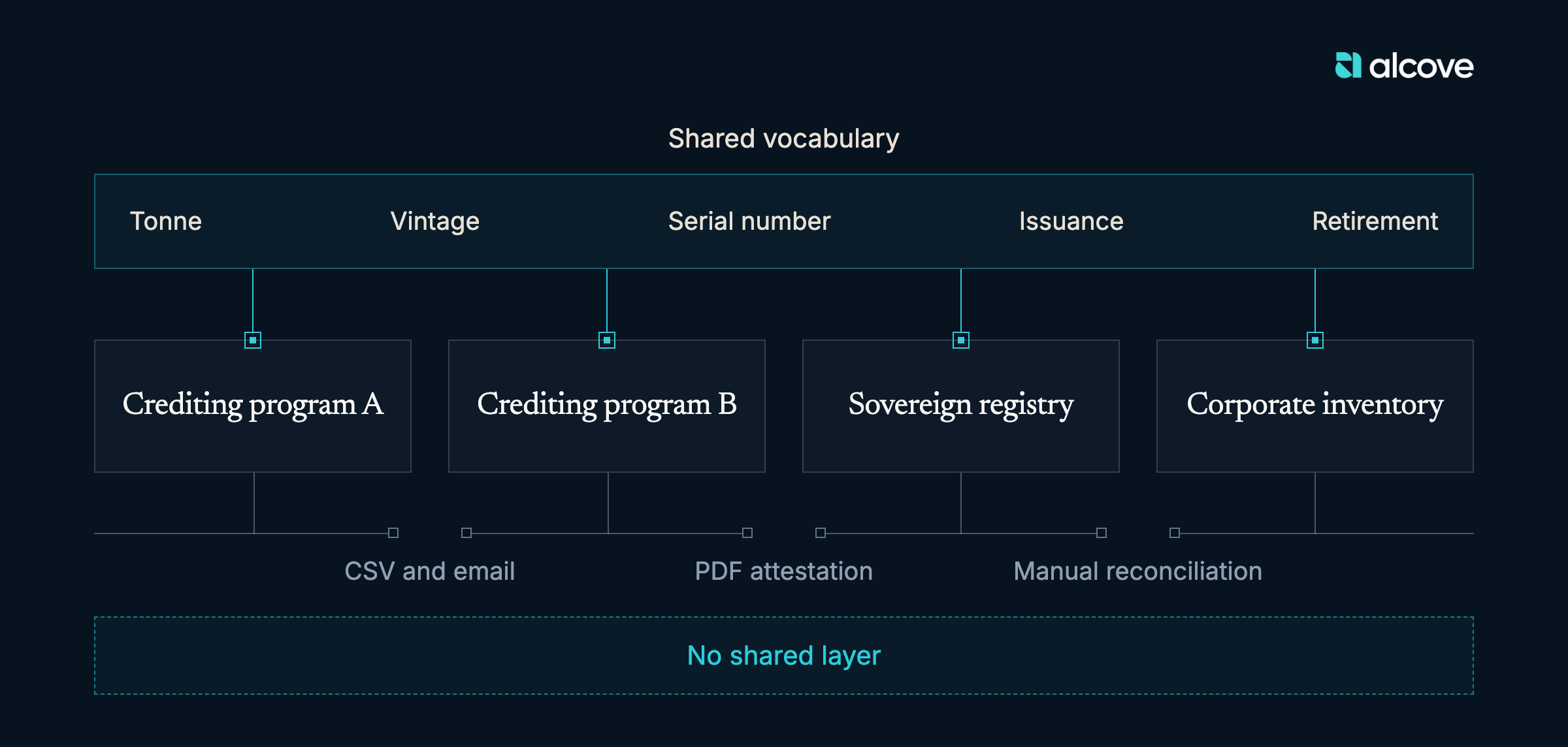
Dozens of crediting programs now exist, and more compliance regimes arrive as Article 6 comes online. Each is meant to attract partner countries, buyers, and finance. Each builds the system that makes its records from the beginning. I’ve worked on enough of those builds to know how much of each one repeats the last.
The market now has a shared vocabulary and no shared layer underneath it.
This is why Alcove exists
Alcove has built that layer: the system where a program's records get made. It's where a program takes in project data, runs review under its own methodology, and issues credits. It keeps what a data model cannot: which reading was chosen and the evidence behind it, which methodology version applied, and what the reviewer asked and what changed. That’s the reference layer these markets don't have yet, and it's the work I joined Alcove to do.
Nobody knows yet which model most countries will adopt, and it may not be one. A country that picks one will still transfer credits with countries and registries that picked another. So the layer has to work with all of them, and a new model or methodology has to be a configuration, not a rebuild. We don't write standards or methodologies. A program on Alcove keeps its own rules, its own approvals, and its own record.
That’s what the Gold Standard and Verra tool needs from the programs that feed it. It's what the partner countries, buyers, and banks a program hopes to attract will ask for. And it's what the countries following Indonesia will need on day one: records that can show how they were made.
I'm in New York for Climate Week. If you're launching a program, modernizing a registry, or preparing for Article 6, let's compare notes.